
Don't Bet Against Tradition
In country music, it always comes back around eventually

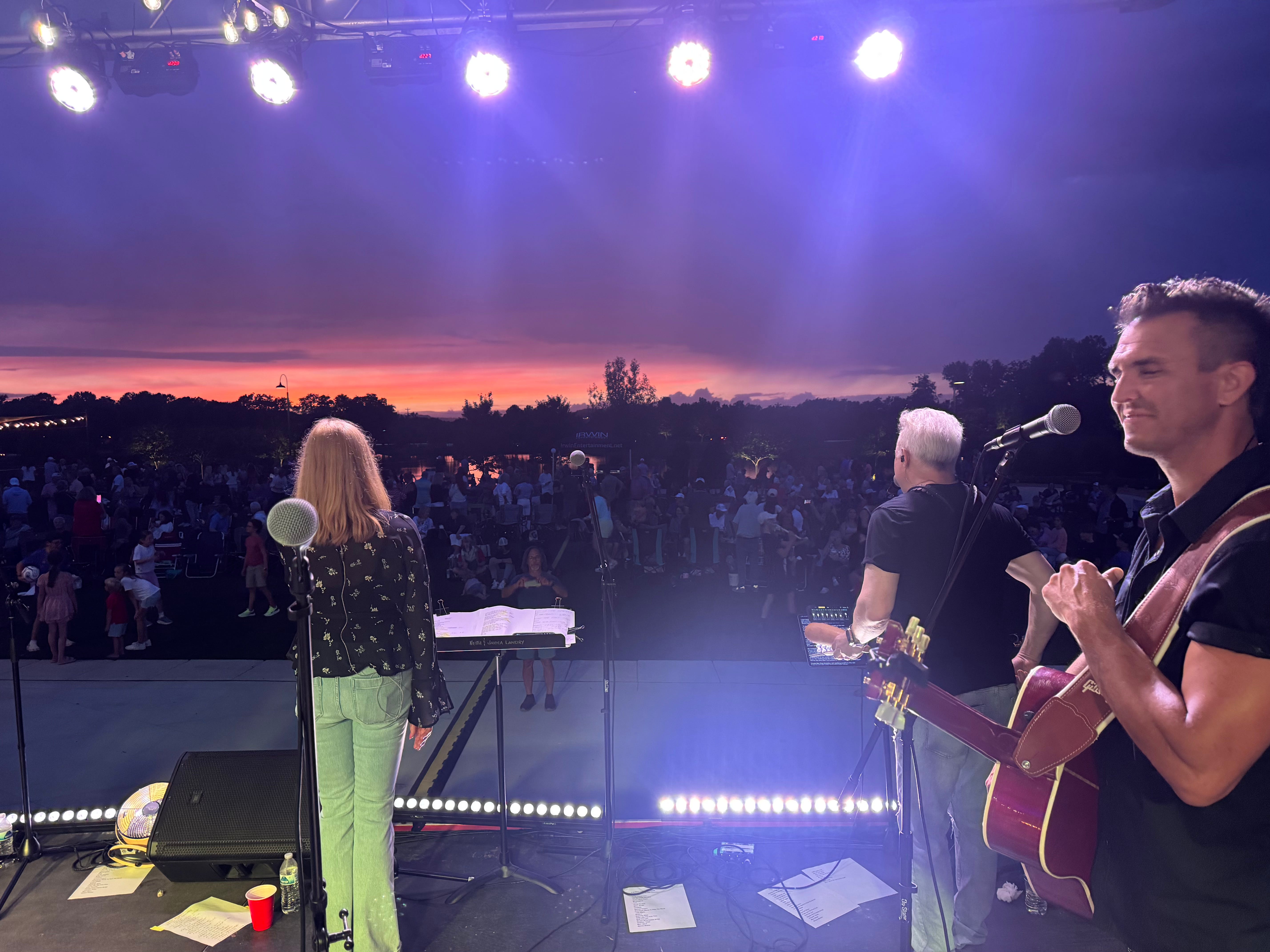
Every Memorial Day for the past decade I play a big lakefront concert in my huge neighborhood with a highly skilled and seasoned cover band of mostly former pro musicians. Our neighborhood in Franklin has over 2,500 homes—as you’d guess, there are some very talented singers and pickers. This year I played guitar on about a dozen songs and this year I sang one, Suffragette City by David Bowie.
Most of our material is either classic rock, 90s alternative, or dance party funk to close out the night. What’s typically absent from our set is anything remotely country. That is, until this year. A young singer asked to sing “Choosin’ Texas” by Ella Langley.
I wanted to play guitar on “Choosin’ Texas” for a couple reasons. For one, it has a really cool recurring lick played by two electric guitars in harmony in a call-and-response with a plaintive pedal steel. I knew it would be fun to play. But also I just happen to love the song. Langley has a traditional sound. Most of her songs—including “Choosin’ Texas”—would have worked just fine in the 1970s. It’s simple, direct storytelling, a heartbreak song of sorts, that doesn’t have the hallmarks of a modern country crossover hit. But it is, in fact, a massive crossover hit.
Langley is arguably the biggest breakout country star of the 2020s. Like other contenders for that title—Lainey Wilson, Shaboozey, Jelly Roll, perhaps Zach Top—Langley doesn’t fit within an acceptable category of breakout country stars from the previous era. Her breakout success is in spite of—rather than because of—the Music Row promotion machine.
I first paid attention to Langley’s music with her irresistible breakout duet with Riley Green, “you look like you love me.” I found her sultry Alabama drawl irresistible, and I went straight down the rabbit hole—she’s a brilliant singer and writer. It’s an example a classic or even vintage song that broke through in the most modern way—as a TikTok sound. Just a few years ago, back when it mattered, county radio wouldn’t have prioritized a song that unapologetically traditional. But with country music, when it all gets too glitzy and showbiz, tradition always finds a way—even when the industry tries to move on.
The same week when “you look like you love me” is in its tenth week as the number one song on the Hot 100, Luke Bryan is going viral for all the wrong reasons. His new single, Fish Hunt Golf Drink, is a throwback to the bro country era. It’s a song that would have gone unnoticed a decade ago, but now it’s an object of ridicule. It’s a reminder of how far we’ve come from the nadir of the early 2010s, when I first arrived in Nashville.
As I’ve found my way deeper into the country business over the years, I’ve become a fan of more mainstream country music. That isn’t because my tastes have changed—it’s because the music is consistently better. In my opinion we’re in a golden age for country. It’s enormously popular, with countless pop singers crossing over to country—or at least trying to.
Back in the early 2010s, I had a sense that country was about to turn back to traditional sounds. That’s because going back to basics is a feature of country since the industry began in the early 20th Century. The industry pushes the music further and further into pop and away from tradition until the audience rejects all the glitz and glam in favor of traditional storytelling, fiddle and pedal steel, and traditional Southern voices.
When I first heard Sturgill Simpson’s debut album High Top Mountain as a demo and joined his business team back in 2012, I believed he would be the traditional voice that would crack the mainstream. He had the songs, the voice, and the charisma to become a legend, and I assumed the gatekeepers of music row would agree. They didn’t.
At my Music Row law firm, I had a daily audience of Music Row gatekeepers. I passed out a lot of Sturgill demos in 2012 into 2013. I asked people to listen and tell me what they thought. For the few people who listened, I didn’t get much encouragement. Just like with The Civil Wars a couple years earlier, the consensus was that it wasn’t really country music at all. Country music wasn’t a genre—it was a radio format. If they wouldn’t play it on the radio, you had to call it something else. Americana? Heritage Country? Anything but Country—that meant something else.
Then Sturgill found his audience, just as Chris Stapleton found an even bigger audience the following year. Not through radio airplay but by touring, word of mouth, late night television, YouTube. Then social media gave artists a way to build a fanbase directly, and the role of radio declined. Now most artists break out on social media, and often it isn’t the acts that would have found their way when radio ruled. For example, now we have huge stars who are women, people of color, or just beautiful weirdos who wouldn’t have made it past the previous gatekeepers. Today Sierra Ferrell would be the subject of a label feeding frenzy. In 2019, we signed her to Rounder without any competition.
It’s important to note that Langley, our biggest breakout in recent memory, isn’t really even a product of Music Row. After years of regional touring, brick-by-brick artist development, and years on the songwriter round circuit, she broke out on social media and signed to Columbia Records, a West Coast label that’s geographically and structurally off The Row. Unlike her Columbia label mate Megan Maroney, Langley isn’t also signed to Sony Nashville. Her radio promo partner has been Triple Tigers, an independent alternative to the mainstream promo machine.
Coastal labels signing and developing country talent is controversial on The Row. Recently a former major label president issued a recent press release for a new venture that compared outsider labels’ “coastal legitimizing” of country to coal companies strip mining Appalachian land. While I agree that major labels haven’t always been great to—or for—creative musicians, this is awkward coming from a longtime Music Row major label executive.
As a longtime Music Row lawyer, I disagree with this view. Coastal labels have shown up in Nashville in a big way, and they’ve seriously disrupted the dealmaking culture in a way that has been a huge benefit to artists. They’ve brought competition that has forced Music Row labels to offer better deal terms in general. It’s a symptom of country’s popularity, but it’s also been a positive influence on how artists are treated by the industry.
My experience since moving to Nashville is that the Music Row machinery seeks to exercise enormous creative control over the artist development process to shape singers into hitmakers. That goal used to be radio hits. Now artists break on social media and develop an audience before the Nashville star machine has an opportunity to exercise control. The audience loves the artist they’ve discovered and would push back if the sound substantially changed. Labels and managers know better than to second guess what’s already working—therefore development is happening on the artist’s, not the label’s, terms.
The coal analogy is especially poignant because there is a modern day equivalent to coal companies taking the tops off of mountains, and that’s the tech industry, particularly generative AI. It isn’t surprising that the consensus reaction to Luke Bryan’s recent embarrassment is that it was probably written by AI. That’s becoming the go-to when commercial product feels overly processed or manufactured. “That’s probably AI” is the equivalent of “that’s processed mainstream dreck” in a prior era.
The miscalculations of the powers-that-be about the audience’s appetite for AI product have created a media environment where authenticity is paramount. I can’t prove it, but I believe that “Choosin’ Texas” wouldn’t have broken out of the old Music Row model. But as some mainstream executives experiment with implementing AI as a means to reclaim market dominance, traditional sounds and authentic voices have a clear lane ahead, with a diminished country radio following rather than leading.
For the general public, “country” has always been a style, a vibe, a tradition, not a format. Now that the processed sounds of the prior era can be achieved with a simple prompt, audiences want to hear songs and voices that can be reproduced in a live setting by living humans. Who knows where the rest of the industry is headed but for now, don’t bet against tradition.
As a passionate traditional country music fan, I have felt like the past 10-15 years has been one of the alltime low eras for country radio and the Opry. To your point, some excellent artists have emerged such as Sturgill, Stapleton, Margo, Sierra, Turnpike Troubadours and other "Americana" acts who have been unfairly ignored by country radio and Music Row. Just think if they'd embraced these acts and promoted others with similar talent how great country would be. All of the bro country looks and sounds the same, like an auto tune production mill, with a complementary backwards baseball hat. All the ladies are Kelsei and Carrie clones as well. Music Row has only themselves to blame if they are being "coastalized". The fact that no one saw Sierra's talent in Nashville other than you/Rounder speaks volumes.
I just tracked down that Luke Bryan song. Fucking brutal