
The Modern Day Fun Machine

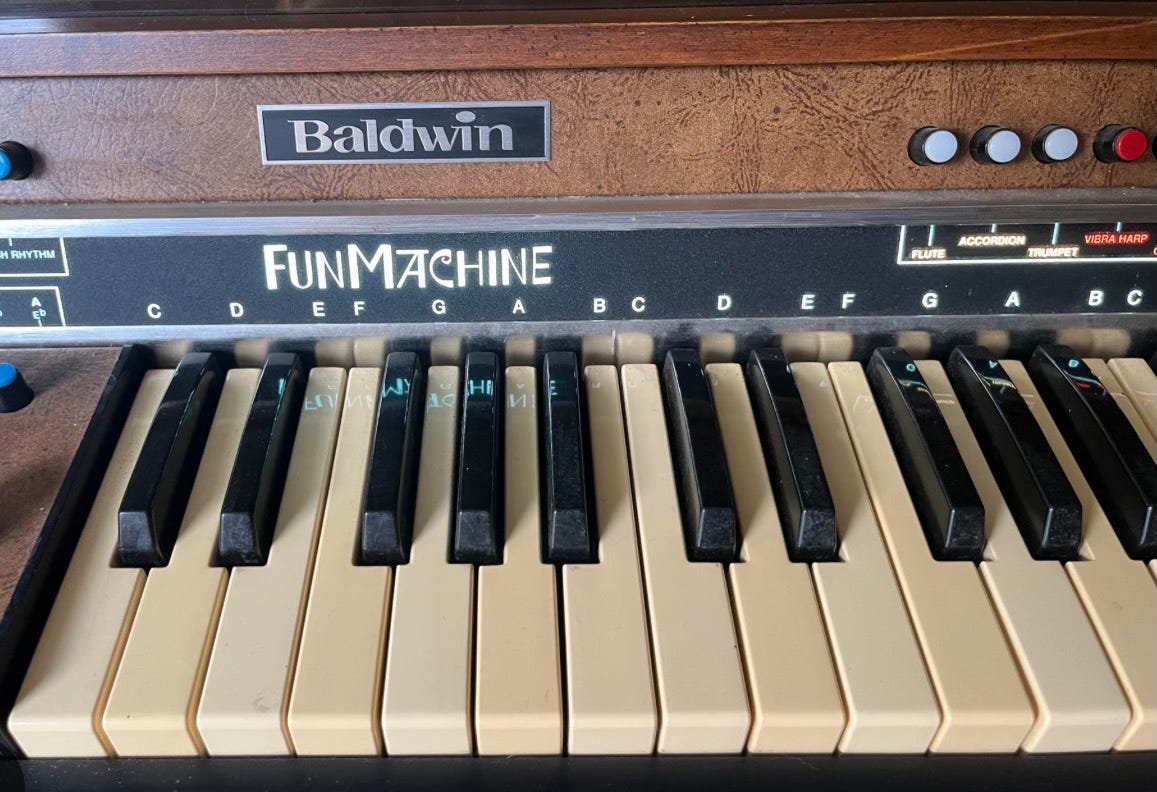
Remember the Baldwin Fun Machine organ? In the late ’70s, I took music lessons at Smith Holden Music in Bloomington, Indiana. I liked to get there a little early so I could play with the Fun Machine on the showroom floor. It had all these cool synth sounds plus programmed beats in styles such as rhumba, Bossa Nova, and four-on-the-floor disco.
The Fun Machine wasn’t meant for professional musicians; it was meant for fun! It was an extension of a console entertainment system, like a television or stereo. In the old days people gathered around the household piano to share songs. Now they could do it with a oompah rhythm. Fun for the whole family!
Suno CEO Mikey Shulman’s vision for the future of AI music predicts Suno’s domination on two fronts: professionals and hobbyists. It’s an expansive vision, but his ambition to exponentially grow the industry won’t occur by simply disrupting professional music creation. The growth will happen—as Shulman describes in his recent Billboard interview—when AI music creation becomes a pastime.
My take is that Shulman isn’t committed to music for music’s sake; he’s primarily a technologist. If you don’t believe me, listen to the aforementioned Billboard On the Record interview. He’s passionate when he talks about disruption and when he defends the legality of Suno. But at the end when he’s asked about his own musical interests, he’s out of his depth. It’s awkward to the point of discomfort. The way he talks about the business of music, he could just as easily be talking about crypto or prediction markets. When he talks about music, he might as well be reading a script.
That isn’t unique in our business. The more lucrative the industry becomes, the more non-music people infiltrate music. I’ve met enough venture capitalists in the music space to know it’s happening more than ever. Music is an asset class, a collection of revenue streams. Revenue streams also attract fraudsters—Suno is a streaming fraudster’s wet dream.
I’ve spent enough time on the r/SunoAI to know that its most enthusiastic adopters aren’t professionals or committed hobbyists—it’s people who believe they have a good shot to become professional musicians, producers, or songwriters (whether or not they contribute anything original) on the app.
I’ve had a couple strange interactions recently where someone who seems sane and rational will tell me they plan to make a career change and pivot into professional music production or songwriting. I ask them about their work, and they send me a dropbox of Suno tracks of various styles and genres. It’s so disorienting for about half a second.
I believe it’s a symptom of the head-spinning disorientation in rapid AI adoption when people convince themselves that because they can easily produce decent quality outputs, they can make music for a living. It’s like they’re in love with their AI creations, wildly overestimating the quality of the tracks based on their own emotional connection with the music. Any creative musician understands the emotional space. We fall in love with our own work, and are often snatched back to reality by an indifferent public reception.
I haven’t had a deep discussion with any of these mostly well-meaning folks about how they hear or think about their tracks, but I can venture a guess. I know from vast experience that exceptionally creative people are wired differently—likely defined as neurodivergence—which leads to obsessive focus on creation. They create because we have to. For truly creative people, making music isn’t a pastime; it’s an obsession. With or without proper equipment, with or without financial incentives, creative people will create. The lucky ones who work at it long enough might even make some money.
Suno is, of course, a creative space. People find their creativity there, and they enjoy creating just like they did on the Fun Machine. That’s fine. Or, rather, it would be fine if Suno weren’t extracting value from the millions of tracks it’s illegally trained on. If prompting AI tracks turned out to be incredibly fun for millions of musical hobbyists, I’d be fine with that. I want people to be creative and have fun.
However, if it’s purely a hobby, there would be no reason to distribute Suno-generated tracks on commercial platforms like Spotify. The point isn’t the creative process that produces the end product; it’s the end product itself. Although it might involve some degree of creativity, prompting an AI model isn’t the same as a creative process from scratch. Most of the creative effort is already done via training the model on existing works. The outputs are ordinary by design. Suno is incapable of creative innovation because it’s a derivative, predictive model built on existing works. It produces average, uninspired tracks that are flooding streaming platforms at incredible scale and finding their way into our discovery algorithms and social feeds.
One of AI music’s talking points is that most people can’t tell the difference between AI music and non-AI music. It came up today in the most recent Billboard On the Record podcast (where we also learned that although there are 50,000 AI tracks uploaded every day, it only makes up 0.5% of Apple Music’s consumption).
I believe the entire topic is a red herring—simply distinguishing AI from human creation misses the point. Although I’m getting better at immediately recognizing Suno outputs, I’m not at all confident I can tell the difference between a Suno track and an ordinary track created by a human with musical instruments, microphones, plug-ins, and a DAW. With the availability of tools such as auto-tune and quantizing, many DIY tracks already sound like they were created by robots. We strive to make recordings perfect because we can, but a perfect recording is a soulless outcome that defeats the purpose of making music. AI tracks suck because they are derivative by design, uninspired—like the vast majority of the vast ocean of tracks on Spotify.
Somehow in this massive cluster of mediocrity, great music still finds its way.
The important test isn’t whether or not it’s AI, it’s whether or not it’s exceptional. I remember a time not so long ago when you’d pay special attention to a well-recorded, high fidelity demo, because the good sound quality meant someone cared about it and spent some money. But now, thanks to Suno, good sounding recordings are the baseline. Studio quality sound has become common enough to have lost its intrinsic value.
If I hear a track that sounds like a record, I don’t assume it’s any good. In fact, I assume it’s slop or DIY crap unless the sound finds its way into my nervous system and raises the hairs on the back of my neck. Like most obsessive music fans, I know it when I hear it. If the output is truly great, and if the model is fairly trained, I don’t care that it’s AI. If AI tools help truly creative people with their craft, I’m fine with that as well. I just don’t think Suno is designed to produce greatness. It’s designed for “good enough.” Good enough for a hobby, good enough for streaming fraud. If abominations like Breaking Rust or The Velvet Sundown are an indication, not nearly good or interesting enough to live up to the hype that Suno outputs will somehow compete with the best human creations.
I’ve been a full-time “professional” musician, though these days I identify as a hobbyist. One thing I agree with Shulman about is that more people should embrace music as a hobby. I am wired to be creative—creativity is a priority for me. I am a product of a culture—namely the 80s and 90s indie/DIY underground—that deemphasized technical proficiency in favor of creative exploration.
The first musical community outside to embrace my band Blake Babies was the Pacific Northwest pop underground exemplified by Beat Happening and other K Records artists—the scene that inspired Kurt Cobain. That scene cooled on us when our records became more professional-sounding—instrumental and vocal proficiency was irrelevant or frowned upon. Originality and creativity were celebrated.
There’s a common theme between that version of the DIY underground that anyone can do it—but the “it” in each case is a polar opposite. In the pop underground, anyone can embrace their creativity to produce something truly original and personal—even if it’s primitive or simply out of tune. With Suno, anyone can produce commercial quality music product without a whiff of innovation or creativity.
I would love to live in a world where a billion people embrace their creativity and make music or other art that expresses their unique human experience without expectation of financial gain. I do not, however, want anything to do with a billion people producing mediocre, unoriginal slop that they hope might make them a few bucks.
Maybe someday generative AI tools will truly enhance creativity and expand our capabilities for true expression at scale. Until then, learn an instrument. Write a song. Make up a story. Support your favorite artists because real artists bring joy and meaning to our lives.
Except the Fun Machine was way more fun.
Perfect illustration with BFM organ.